
Strunk chainsaws are uncommon today, but the company produced a broad range of one-man saws during the 1950s and early 1960s. This list covers every documented production chainsaw sold with the Strunk name, including gasoline models, military-contract saws, and corded-electric machines.
The model names can be confusing. Strunk reused engines and parts families, advertised bow-equipped packages under their own names, and sometimes shortened a model name on the identification plate. The entries below keep every supported designation visible while grouping only names that describe the same powerhead.
A Brief History of Strunk Chainsaws
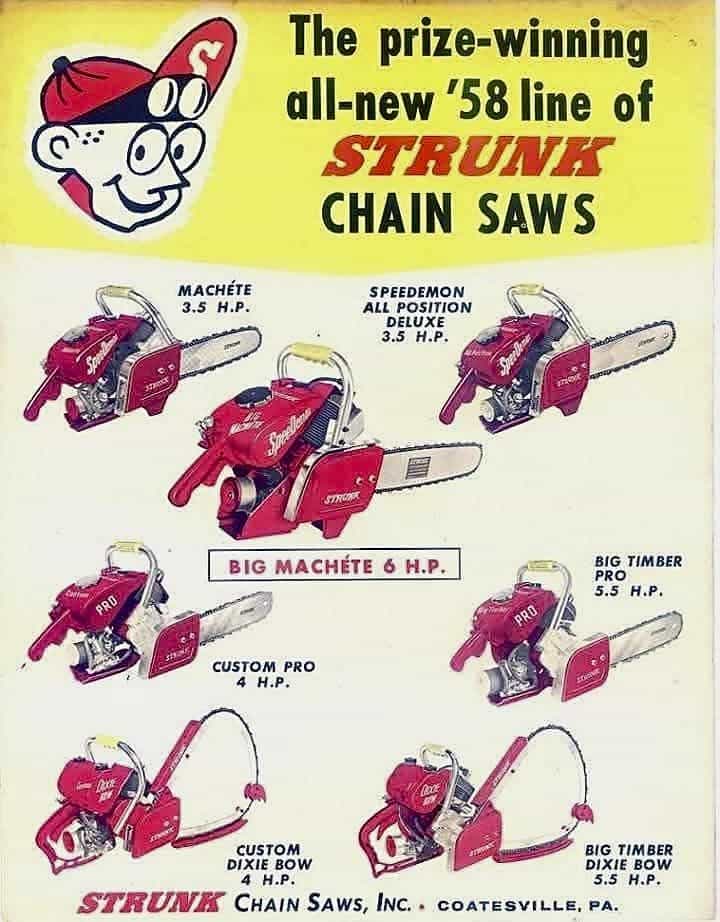
Strunk Manufacturing Company operated in Coatesville, Pennsylvania, and introduced its first chainsaw in 1952. Leonard M. Strunk’s early chain-saw design is documented in a patent filed in 1954. Strunk built the saws and their distinctive chassis, but many gasoline models used established Power Products or West Bend engines. That is why two Strunks can look related while having very different displacement and performance.
The range expanded quickly from geared, 77 cc work saws to lighter direct-drive models, large-displacement timber saws, bow packages, and all-position carburetor versions. The business later appeared as Strunk Power for Modern Living, Inc. The final documented products include military saws made by L-M Manufacturing under the Strunk model name, the GSC-70 gasoline saw, and several large corded-electric machines.
Early Strunk Chainsaws, 1952-1956
Strunk 3-19

- Production years: 1952-1954
- Displacement: 77 cc (4.7 cu. in.)
- Power: 1.5 kW (2 hp)
- Weight: 12.7 kg (28 lb), powerhead only
- Guide-bar range: 41-61 cm (16-24 in.)
The 3-19 was Strunk’s first documented production saw. It used a Power Products AH47 engine and 3:1 gear reduction. Strunk also manufactured closely related David Bradley 355-series saws for Sears, but those private-label machines were not Strunk-branded and are not separate entries here.
Strunk Eager Beaver

- Production years: Introduced 1954
- Displacement: 77 cc (4.7 cu. in.)
- Power: 1.9 kW (2.5 hp), period advertised rating
- Weight: 12.7 kg (28 lb), powerhead only
- Guide-bar range: 41-48 cm (16-19 in.)
This geared AH47-powered model retained a float carburetor. Period sales literature advertised 2.5 hp, while some later technical summaries list 2 hp. See our Eager Beaver overview for more info.
Strunk P3 / P-3 / P 3-19
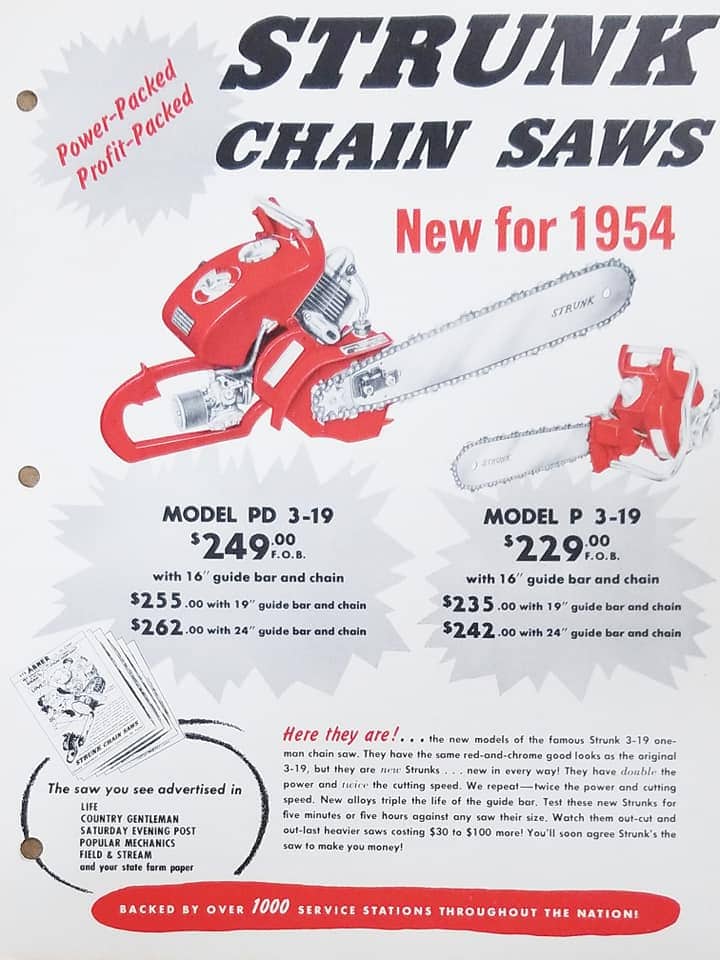
- Production years: Introduced 1954
- Displacement: 77 cc (4.7 cu. in.)
- Power: 1.5 kW (2 hp)
- Weight: 12.7 kg (28 lb), powerhead only
- Guide-bar range: 41-61 cm (16-24 in.)
P3 is the factory parts-list spelling, P-3 is the common model-profile form, and period advertising used P 3-19. All refer to the same geared, float-carburetor saw.
Strunk PD3 / PD-3 / PD 3-19
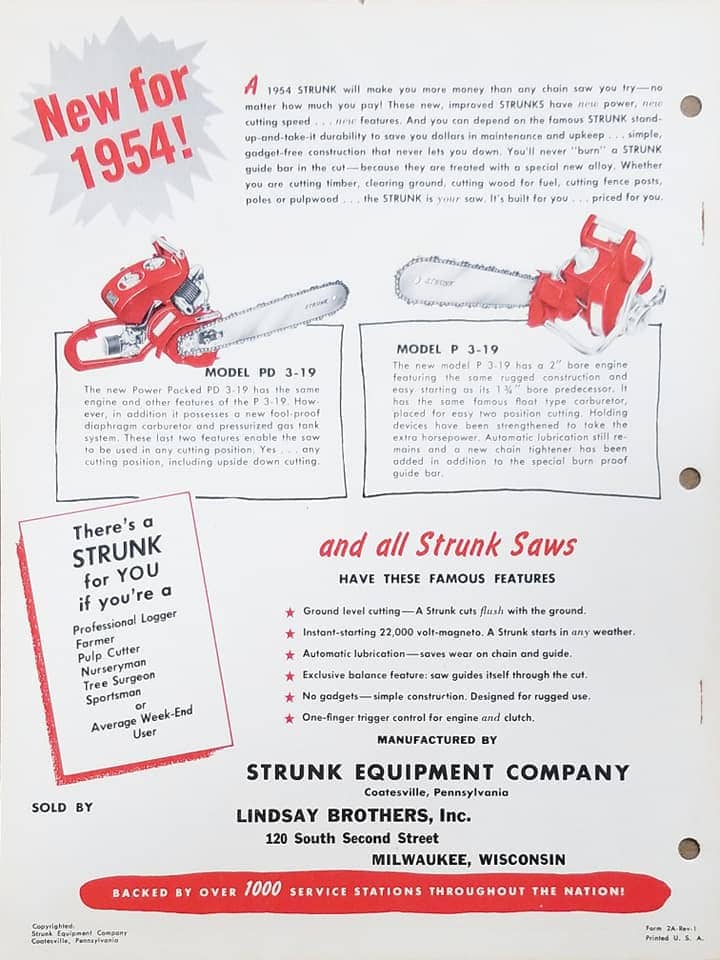
- Production years: Introduced 1954
- Displacement: 77 cc (4.7 cu. in.)
- Power: 1.5 kW (2 hp)
- Weight: 12.7 kg (28 lb), powerhead only
- Guide-bar range: 41-61 cm (16-24 in.)
The PD3 is not merely another spelling of P3. Its Tillotson diaphragm carburetor allowed all-position cutting, while the P3 used a float carburetor. A dated advertisement identifies the PD 3-19 as new for 1954, correcting later references that give 1956.
Strunk SpeeDemon

- Production years: Introduced 1954
- Displacement: 83.5 cc (5.1 cu. in.)
- Power: 3.7 kW (5 hp)
- Weight: 12.2 kg (27 lb), powerhead only
- Guide-bar range: 41-61 cm (16-24 in.)
The original SpeeDemon was a direct-drive West Bend-powered saw. It should not be combined with the later 77 cc SpeeDemon Special or Deluxe.
Strunk SpeeDemon Special / SDS

- Production years: Introduced 1955
- Displacement: 77 cc (4.7 cu. in.)
- Power: 2.6 kW (3.5 hp)
- Guide-bar range: 41-48 cm (16-19 in.)
The Special used the Power Products AH47 engine, direct drive, a float carburetor, and automatic chain oiling. SDS is identification-plate shorthand for SpeeDemon Special, not another model.
Strunk SpeeDemon Deluxe / SpeeDemon All-Position / SpeeDemon A.P. / SpeeDemon All Position Deluxe

- Production years: Introduced 1955
- Displacement: 77 cc (4.7 cu. in.)
- Power: 2.6 kW (3.5 hp)
- Weight: 11.3 kg (25 lb), powerhead only
- Guide-bar range: 41-48 cm (16-19 in.)
These names identify the diaphragm-carburetor Deluxe family, not materially different saws. A.P. is shorthand for all-position. A 1958 Strunk advertisement calls it the SpeeDemon All Position Deluxe, while the factory parts index shortens the name to SpeeDemon All-Position.
Strunk Big Timber SpeeDemon

- Production years: Introduced 1955
- Displacement: 105 cc (6.4 cu. in.)
- Power: 3.7 kW (5 hp), period advertised rating
- Weight: 12.2 kg (27 lb), powerhead only
- Guide-bar range: 41-61 cm (16-24 in.)
This was the large West Bend-powered member of the early SpeeDemon family. Surviving service data also gives 4 hp at 4,500 rpm, reflecting a lower-speed rating rather than a different documented model.
Strunk Busy Beaver / BB

- Production years: Documented in late 1955; commonly cataloged as a 1956 introduction
- Displacement: 77 cc (4.7 cu. in.)
- Power: 3.0 kW (4 hp)
- Weight: 12.7 kg (28 lb), including a 41 cm (16 in.) bar and chain
- Guide-bar range: 41-61 cm (16-24 in.)
A November 17, 1955 dealer advertisement establishes that the Busy Beaver was already on sale before the often-repeated 1956 date. BB on a plate or parts reference is an abbreviation, not a separate model.
Strunk Custom Pro / Custom Dixie Bow / Dixie Bow

- Production years: Documented in late 1955; widely advertised in 1957-1958
- Displacement: 77 cc (4.7 cu. in.)
- Power: 3.0 kW (4 hp)
- Weight: 10.9 kg (24 lb), powerhead only
- Guide-bar range: 36-76 cm (14-30 in.)
Custom Dixie Bow and the factory’s shorter Dixie Bow designation describe the Custom Pro sold with a bow cutting attachment. They are bar packages, not separate engines or chassis.
Strunk Gasoline Chainsaws, 1957-1959

Strunk Shur-Kut / SK
- Production years: Introduced 1957
- Displacement: 64 cc (3.9 cu. in.)
- Power:
- Weight: 11.3 kg (25 lb), powerhead only
- Guide-bar range: 41-48 cm (16-19 in.)
The standard Shur-Kut was a 3:1 gear-drive model with a Tillotson float carburetor and manual chain oiler. SK on surviving parts and collector records is model shorthand, not a separate saw.
Strunk Shur-Kut A.P.
- Production years: Documented in 1957
- Displacement: 64 cc (3.9 cu. in.), shared Shur-Kut factory family
- Power: 2.42 kW (3.25 hp)
- Weight: 11.3 kg (25 lb) for the shared Shur-Kut chassis
- Guide-bar range: 41-48 cm (16-19 in.), shared family listing
A.P. means all-position. The factory listed Shur-Kut and Shur-Kut A.P. separately because the A.P. version used all-position carburetion, even though the two belong to the same basic parts family.
Strunk Speed-Kut
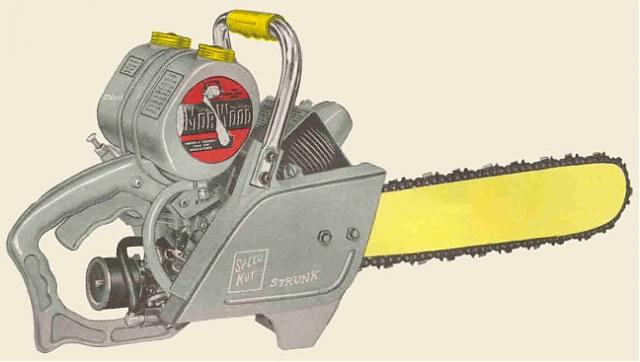
- Production years: Introduced 1957
- Displacement: 77 cc (4.7 cu. in.)
- Power: 2.6 kW (3.5 hp)
- Weight: 9.5 kg (21 lb), powerhead only
- Guide-bar range: 41-48 cm (16-19 in.)
The 1960-1961 parts list assigns separate compatibility codes to gray and red Speed-Kut saws, but it does not identify them as mechanically different models. They are grouped here. The Morwood Direct Drive was a related Strunk-built private-label saw, but it did not carry Strunk branding.
Strunk Most-Kut
- Production years: Introduced 1957
- Displacement: 77 cc (4.7 cu. in.)
- Power: 2.6 kW (3.5 hp)
- Weight: 11.3 kg (25 lb), powerhead only
- Guide-bar range: 41-61 cm (16-24 in.)
The Most-Kut combined the Power Products AH47 engine with 3:1 gear reduction, all-position carburetion, and a manual chain oiler.
Strunk Big Timber
- Production years: Introduced 1957
- Displacement: 105 cc (6.4 cu. in.)
- Power: 3.0 kW (4 hp) at 4,500 rpm
- Weight: 13.6 kg (30 lb), powerhead only
- Guide-bar range: 41-48 cm (16-19 in.)
The plain Big Timber was a direct-drive West Bend saw. It is distinct from both the earlier Big Timber SpeeDemon and the geared Big Timber Pro.
Strunk Big Timber Pro / Big Timber Dixie Bow

- Production years: Introduced 1957
- Displacement: 95 cc (5.8 cu. in.)
- Power: 4.1 kW (5.5 hp)
- Weight: 13.2 kg (29 lb), powerhead only
- Guide-bar range: 41-76 cm (16-30 in.)
Big Timber Dixie Bow was the bow-equipped package for this geared West Bend-powered model.
Strunk SpeeDemon Machete 4.7 / Machete

- Production years: Introduced 1957
- Displacement: 77 cc (4.7 cu. in.)
- Power: 2.6 kW (3.5 hp)
- Weight: 11.3 kg (25 lb), powerhead only
- Guide-bar range: 41-48 cm (16-19 in.)
The 1958 range advertisement shortened this model’s name to Machete and rated it at 3.5 hp. The 4.7 suffix distinguishes its 77 cc Power Products engine from the 5.1 cu. in. West Bend version.
Strunk SpeeDemon Machete 5.1
- Production years: Introduced 1957
- Displacement: 83.5 cc (5.1 cu. in.)
- Power: Not stated in located model-specific literature
- Weight: 12.2 kg (27 lb), powerhead only
- Guide-bar range: 41-48 cm (16-19 in.)
This version used a West Bend engine. Its displacement does not justify copying the original 5 hp SpeeDemon rating, so no unsupported power figure is assigned here.
Strunk Machete B/T / Machete Big Timber
- Production years: Introduced 1957
- Displacement: 83.5 cc (5.1 cu. in.)
- Power: Not stated in located model-specific literature
- Weight: 13.2 kg (29 lb), powerhead only
- Guide-bar range: 41-48 cm (16-19 in.)
Machete B/T is the exact abbreviated factory-list designation. Its greater published weight separates it from the 27 lb SpeeDemon Machete 5.1.
Strunk Big Machete

- Production years: Advertised in the all-new 1958 range
- Displacement: 105 cc (6.4 cu. in.)
- Power: 4.5 kW (6 hp), period advertised rating
- Weight: 13.6 kg (30 lb), powerhead only
- Guide-bar range: 41-48 cm (16-19 in.)
The 1958 advertisement establishes the 6 hp sales rating and an earlier date than the sometimes-cited 1959 introduction. Surviving service data rates the West Bend engine at 4 hp at 4,500 rpm, which appears to use a different rating speed.
Strunk 90
- Production years: Introduced 1959
- Displacement: 105 cc (6.4 cu. in.)
- Power: 3.0 kW (4 hp) at 4,500 rpm
- Weight: 13.6 kg (30 lb), powerhead only
- Guide-bar range: 41-48 cm (16-19 in.)
The factory parts index gives the Strunk 90 its own code, separate from the Big Machete. The Strunk 90 is documented with a sand-cast aluminum chassis, while the Big Machete specification identifies magnesium construction.
Late and Military Strunk Gasoline Chainsaws, 1960-1961
Strunk Big Pro
- Production years: Documented by the 1960-1961 factory master parts list
- Displacement:
- Power:
- Weight:
- Guide-bar range:
Big Pro appears as its own factory designation and parts-compatibility group.
Strunk Harvestor
- Production years: Documented by the 1960-1961 factory master parts list
- Displacement:
- Power:
- Weight:
- Guide-bar range:
Harvestor, spelled with “-or” in the factory document, has its own parts code. It shares a broad parts group with the Strunk 90.
Strunk G-3 / G3
- Production years: 1960 military-contract production
- Displacement: 95 cc (5.8 cu. in.), from the documented Power Products AH58 engine
- Weight: No published figure located
- Guide-bar range: 46 cm (18 in.)
A surviving U.S. military nomenclature plate reads “Saw, Chain, Gasoline Driven; 18 Inch,” identifies L-M Manufacturing as the maker, and gives the model as Strunk G-3. Photographs of the plate and military manual confirm the branding, 18-inch size, and March 1960 manufacture. The G-3 was direct drive.
Strunk GSC-70
- Production years: Introduced 1961
- Displacement: 97 cc (5.9 cu. in.)
- Power: Approximately 3.7 kW (5 hp)
- Weight: No published figure located
The GSC-70 is the latest dated Strunk gasoline model found in the model records.
Strunk Corded-Electric Chainsaws
No genuine Strunk-branded battery chainsaw was found in period catalogs, model indexes, application catalogs, or collector records. The documented electric models are corded industrial or military machines.
Strunk G2E
- Production years: 1960 military-contract production
- Displacement: Not applicable; electric
- Power: Not stated on the surviving nomenclature plates or in located model-specific literature
- Guide-bar range: 61 cm (24 in.)
The G2E was a gear-reduction military saw built by L-M Manufacturing and marked Model Strunk G2E. Surviving U.S. Army Corps of Engineers plates call it a Type III, 24-inch electric-motor-driven chain saw and carry 1960 manufacture dates. Collector photographs preserve a July 1960 example.
Strunk C-E / C.E.
- Production years: Early 1960s; exact production span not published
- Displacement: Not applicable; electric
- Weight: No published figure located
- Guide-bar range: 41-76 cm (16-30 in.)
The C-E was a one-man, direct-drive saw with a clutch and a 60 Hz universal motor. C.E. is the punctuation used on a surviving plate, not a different model. A documented C.E. restoration shows a 115-volt, 26-amp identification plate and estimates roughly 3.0 kW (4 hp) of electrical input.
Strunk ECS
- Production years: Introduced 1961
- Displacement: Not applicable; electric
- Power:
- Weight:
- Guide-bar range:
The ECS has a separate 1961 model record and a documented clutch.
Strunk Chainsaws
Strunk’s catalog lasted only about a decade, yet it covered small and large gasoline saws, geared and direct-drive designs, all-position variants, bow packages, military equipment, and unusually powerful corded-electric models.
The surviving record is incomplete, especially for the Big Pro, Harvestor, and final electric saws, but factory nomenclature and dated evidence make it possible to separate real Strunk models from abbreviations, private labels, and collector lore. Get in touch if you can fill in any gaps!

Great article, thank you for posting it. I have a very nice Eager Beaver and a couple of Strunk David Bradley in various conditions. The Eager Beaver is one of my favorites.